
Pit Bull Training in Birmingham, Alabama
Off Leash K9 Training Birmingham trains pit bulls to be calm, obedient, off-leash companions using structured, breed-informed methods — not stereotypes. Programs run $100 to $3,500, from puppy consultations to 2-week Board & Train, out of our Pelham, AL facility serving Birmingham, Hoover, Vestavia Hills, and Central Alabama. Rated 5.0★ by 100 local families.
Breed-Informed Off-Leash Training for American Pit Bull Terriers, AmStaffs, Staffies & American Bullies
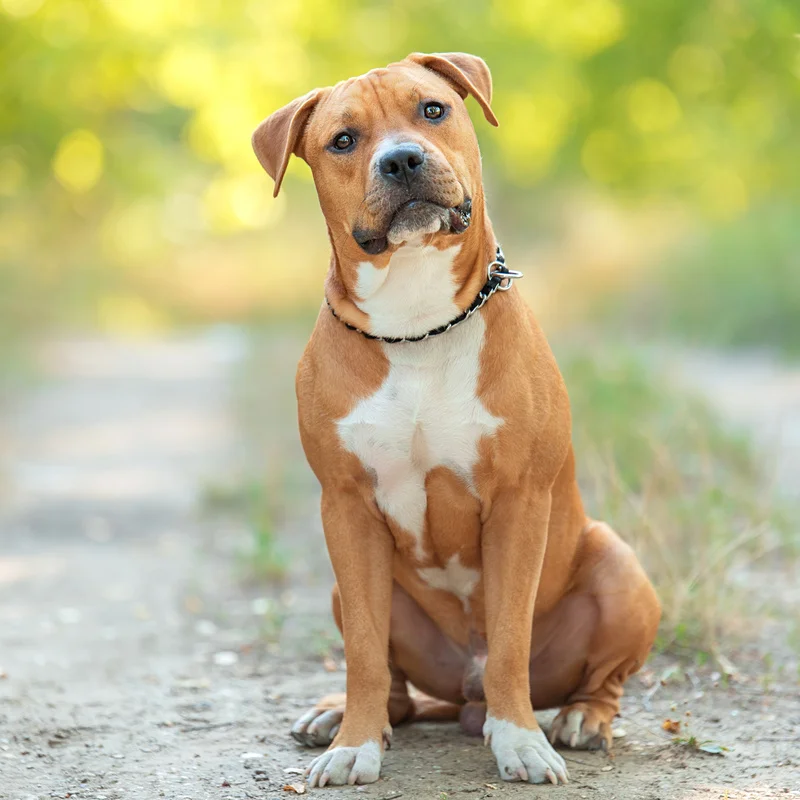
The Truth About Pit Bull Temperament
"Pit bull" is not a single breed — it's an umbrella term covering the American Pit Bull Terrier, American Staffordshire Terrier, Staffordshire Bull Terrier, and American Bully. These breeds share a stocky, muscular build and a temperament history rooted in close human contact, which is why 19th- and early-20th-century Americans nicknamed them "nanny dogs" for their patience with children.
Myth #1: "Pit bulls are inherently aggressive." The data doesn't support it. The American Temperament Test Society has historically scored American Pit Bull Terriers at a pass rate around 87% — on par with or higher than many breeds considered "family friendly," including Golden Retrievers and Beagles. A widely cited 2014 study in the Journal of Veterinary Behavior likewise found no reliable link between breed and aggression when body size and individual history were controlled for.
Myth #2: "Pit bulls have locking jaws." Anatomically false. Veterinary researchers have studied pit bull skulls and jaw musculature extensively, and the structure is identical to any other dog's. What pit bulls do have is a strong bite from a muscular head and neck — a function of build, not a special mechanism.
None of this means training doesn't matter. It means the opposite: because pit bulls are strong, athletic, and deeply bonded to their people, training is what turns that raw drive into a dog you can trust anywhere — not despite the breed, but because of how the breed responds to structure. That's why we build every plan around the individual dog, the same way we do across our breed-specific training programs.
Intelligence and Drive
Pit bulls are quick problem-solvers with strong "people focus" — they watch faces, read tone, and actively try to figure out what earns your approval. That combination of intelligence and motivation is exactly what makes structured training effective: a pit bull that understands what you want and wants to please you learns fast. It also means an under-trained or under-exercised pit bull gets creative in the wrong direction — chewing, counter-surfing, digging, or escaping a yard out of boredom rather than defiance.
Athleticism and Physical Power
Adult pit bulls typically weigh 30–70 pounds of dense muscle, and most can pull, jump, and sustain activity longer than owners expect. That strength is manageable with the right foundation — leash pressure, impulse control, and reliable recall — but it is genuinely difficult to manage without it. This is one reason board-and-train immersion works so well for the breed: strength paired with structure is an asset; strength paired with no structure becomes a daily struggle.
Are Pit Bulls Difficult to Train?
No — pit bulls are not naturally difficult to train. They are food- and praise-motivated, people-focused dogs that rank among the more trainable breeds when structure and consistency start early. Reports of "stubbornness" usually trace back to inconsistent handling or an under-exercised dog, not the breed itself.
In our experience training pit bulls throughout Birmingham, the dogs that struggle are almost always dogs that haven't been given clear rules yet — not dogs incapable of learning them. Once a pit bull understands the rules of the household and what's expected in public, the breed's intelligence and desire to please take over. The commands themselves (come, sit, place, heel, down, off) aren't harder for a pit bull to learn than for a Labrador or a Border Collie. What's different is the payoff for getting training right: a well-trained pit bull is far more welcome in apartments, parks, pet-friendly patios, and boarding facilities that otherwise restrict the breed on sight.
Can an Aggressive Pit Bull Be Trained?
In most cases, yes — but expectations should be realistic. Structured obedience combined with behavior modification resolves or meaningfully improves aggression in the majority of dogs we evaluate. Severe bite cases require an in-person evaluation first, and a small number of dogs will always need some lifelong management around specific triggers.
We're straightforward about this because pit bull owners deserve honesty, not a sales pitch. Aggression in any breed — dog-selectivity, leash reactivity, resource guarding, or fear-based aggression toward strangers — has an underlying cause, and that cause determines the plan. Some pit bulls need obedience-first structure with behavior modification worked in around triggers; that's what our lesson-based Aggression Management program addresses. Dogs with a bite history or more serious cases need the immersive, two-week Aggression Board & Train, which requires an evaluation before enrollment so our trainers understand exactly what they're working with before your dog arrives. What we won't do is promise a personality transplant. What we will promise is that you'll leave with the tools, timing, and understanding to keep your dog — and everyone around your dog — safe and calm.
What Is the Best Age to Train a Pit Bull?
The best age to start is 8 weeks old, using short, positive puppy lessons focused on socialization, crate manners, and bite inhibition. Formal obedience with an e-collar typically begins around 5 months, once a pit bull's attention span and body are ready for it. Adult and rescue pit bulls train just as well — age is not a barrier.
Puppyhood is when the foundation gets built, but it's not when heavy-duty obedience should start — a 10-week-old pit bull puppy simply doesn't have the attention span or physical development for it yet. That's why our puppy programs (Puppy Consultation, AKC S.T.A.R. Puppy, and Puppy Board & Train) focus on socialization, potty training, and basic foundation commands for pups under 5 months, while our full Basic Obedience and Board & Train programs are built for dogs 5 months and older. If you adopted an adult pit bull from a shelter or rescue, don't wait — adult pit bulls often focus better than puppies because the adolescent chaos phase is behind them.
At What Age Do Pit Bulls Calm Down?
Most pit bulls start to mellow between 2 and 3 years old, once adolescence and the bulk of their physical growth are behind them, though energy levels vary by individual dog and bloodline. Consistent obedience training and daily structured exercise noticeably speed up that maturity curve.
Pit bulls mature slower than a lot of owners expect — the "puppy energy" phase can stretch well past the first birthday, which is often when frustrated owners call us. Training doesn't rush biology, but it does give a still-maturing pit bull an outlet for that energy and a set of rules to operate inside of while their brain catches up to their body. Dogs that get structured training in that 1–2 year window tend to settle noticeably faster than dogs left to "grow out of it" on their own.
How We Train Pit Bulls in Birmingham
We use a balanced training approach — positive reinforcement paired with clear, fair communication — because it plays directly to a pit bull's strengths. Positive reinforcement builds the desire to work with you; clear structure (including e-collar conditioning once a dog is ready) gives you a reliable way to communicate off-leash, at a distance, around real distractions. Every program is taught by trainers who are OLK9 Academy Elite Certified, part of the national Off Leash K9 Training network founded by a former US Marine and US Secret Service K9 handler — the same training standards used for working and service dogs, scaled for family pets.
Despite the tough-guy reputation, pit bulls are sensitive dogs underneath the muscle. They read frustration and inconsistency quickly, and they shut down or escalate under handling that's unfair or unclear. Our trainers work firm-but-fair: clear expectations, enthusiastic rewards for good choices, and corrections that are timed and proportionate rather than emotional. That combination is what lets a strong, high-drive dog learn to choose calm behavior on its own — the goal of true off-leash reliability.
Training also happens in real Birmingham environments, not just inside a facility. Commands get practiced at places like Railroad Park, Red Mountain Park, Oak Mountain State Park, and pet-friendly patios around Hoover and Homewood — because a pit bull that's perfectly behaved in a quiet training room but falls apart at a farmers market hasn't actually finished training.
Why Socialization Matters So Much for Pit Bulls
If one thing determines whether a pit bull grows into a confident, easygoing adult or a reactive, anxious one, it's socialization — arguably more than for most breeds, given how much public scrutiny pit bulls face. Puppies have a critical socialization window between roughly 3 and 16 weeks of age, during which their brains are absorbing what's "normal" and safe. A pit bull puppy well-socialized during this window is far less likely to develop fear-based reactivity or dog-selectivity later.
Proper socialization means controlled, positive exposure to men, women, children, people in hats and uniforms, well-mannered dogs of different sizes, new environments, and everyday sounds like traffic, thunder, and vacuum cleaners. It is not the same as "let them meet every dog at the dog park" — uncontrolled introductions can just as easily create a bad association as a good one, which is why our puppy and board-and-train programs handle dog-to-dog socialization in structured settings with known, stable dogs rather than random encounters.
Socialization doesn't stop at 16 weeks, either. Many pit bulls develop "dog selectivity" as they mature into adolescence and adulthood — meaning they may not want to be best friends with every dog they meet, even with a great socialization history. That's normal and manageable; it does not mean training failed. Our goal isn't to turn every pit bull into a dog-park social butterfly — it's to make sure your dog can stay calm, controlled, and non-reactive around other dogs in daily life, whether that's on a sidewalk, at the vet, or on a patio.
Pit Bull Training Programs & Prices in Birmingham, AL
Every program below includes an e-collar and leash, and pricing is the same for pit bulls as for any other breed we train — we don't charge a "bully breed premium." Compare every package on the full pricing page.
- Your pit bull lives and trains with an OLK9 Academy Elite Certified trainer for two immersive weeks
- Masters all 7 commands — come, sit, place, heel, down, break, off — with real-world distraction-proofing
- 2-hour owner handoff session and lifetime support on qualifying programs
- Weekly private lessons covering the same 7 core commands
- Ideal for owners who want to be hands-on throughout the process
- E-collar and training leash included
- Built for dog-selectivity, leash reactivity, and mild-to-moderate anxiety — the most common issue we see in adolescent and adult pit bulls
- Structure reinforced where your dog actually lives
- For bite history, human aggression, or cases that haven't responded to lessons
- Full 7-command foundation plus targeted behavior modification
- Lifetime support on the obedience portion
- Crate training, bite inhibition, potty training, and early socialization
- The foundation phase before formal obedience begins
- The same Basic Obedience curriculum, delivered at your home within 20 miles of Birmingham
- Useful when early-stage reactivity makes transport harder
*Guarantee details: our results, satisfaction, and lifetime support/refresher guarantees apply to select programs only, and terms vary by program. Contact us for the full guarantee terms that apply to your dog's program.
Not sure which fits? Call (205) 402-8448 for a free phone consultation, or take the 2-minute Dog Assessment Quiz for a personalized recommendation.
What Pit Bull Training Looks Like in Real Birmingham Homes
These are illustrative composite scenarios based on common situations we see with pit bull owners across Birmingham — not individual named clients or testimonials. For verified five-star reviews from real Alabama families, visit our testimonials page or the before-and-after video library.
The Hoover Rescue & the Dog-Selective Adult Pit Bull
A Hoover family adopts a 3-year-old American Staffordshire Terrier mix from a local rescue. He's affectionate at home but lunges and barks at other dogs on walks, making the neighborhood route a source of daily stress. An evaluation finds no bite history — just under-socialization and no leash structure. After a 2-Week Board & Train, the dog holds a calm heel past other dogs at a distance and responds to "off" and "place" reliably at home, turning walks back into something the family looks forward to instead of dreads.
The Trussville Family & the Under-Socialized Puppy
A Trussville family brings home a 10-week-old American Bully puppy and quickly realizes bite inhibition and potty training are not going well on their own. Rather than wait for bad habits to set, they enroll in the 2-Week Puppy Board & Train. By graduation, the puppy is crate-trained, has age-appropriate bite manners, and has had structured, positive introductions to other calm dogs — a foundation the family builds on with the AKC S.T.A.R. Puppy Package once he's a little older.
The Vestavia Hills Household & the Pit Bull With a Bite History
A Vestavia Hills family's 4-year-old pit bull nips a family member during a resource-guarding incident over a food bowl. Frightened and unsure what to do, they call for an evaluation rather than wait for it to happen again. The evaluation confirms fear-based resource guarding rather than general aggression, and the family enrolls in the Aggression Board & Train. Two weeks later, the dog has the full obedience foundation plus specific protocols for mealtime and object exchanges — and the family understands, honestly, that ongoing management around food is part of life with this dog, not a problem that simply disappears.
Why Birmingham Pit Bull Owners Choose Off Leash K9 Training Birmingham
Every pit bull is evaluated as an individual, not judged on appearance or reputation before we've even met them. Same programs, same prices, same expectations as every other breed we train.
We understand pit bull patterns — dog selectivity, high drive, sensitivity under a tough exterior, and heat sensitivity in Alabama summers — and adjust training accordingly.
OLK9 Academy Elite Certified trainers, part of a national network founded by a former US Marine and US Secret Service K9 handler — military-grade methodology, scaled for family pets.
Commands are proofed at Railroad Park, Oak Mountain State Park, and pet-friendly patios around Hoover and Homewood — not just inside a training room.
Free refresher help on qualifying programs — next month or five years from now. We're invested in your pit bull's long-term success.
Especially for aggression cases: we tell you what's realistic for your dog, not just what's easy to sell. Sometimes that means recommending the less expensive program.
*Guarantee details: our results, satisfaction, and lifetime support/refresher guarantees apply to select programs only, and terms vary by program. Contact us for the full guarantee terms that apply to your dog's program.
Rated 5.0★ from 100 Google reviews, Off Leash K9 Training Birmingham trains pit bulls out of a dedicated facility at 241 Commerce Pkwy, Pelham, AL 35124 — serving Birmingham, Hoover, Vestavia Hills, Mountain Brook, Homewood, Alabaster, Helena, Chelsea, Calera, Trussville, and the rest of Central Alabama.
Pit Bull Training Questions, Answered
Let's Show Birmingham What Your Pit Bull Can Do
Your pit bull isn't a stereotype — they're a dog who needs the right structure to become the confident, obedient companion you already know is in there.
Call for a Free Consultation Take the 2-Min Quiz
Off Leash K9 Training Birmingham
Training by Breed •
German Shepherds •
Labradors •
Huskies •
Australian Shepherds •
All Prices
241 Commerce Pkwy, Pelham, AL 35124 • (205) 402-8448 • Mon–Fri 8 AM–8 PM • Sat 8 AM–6 PM • Sun 10 AM–6 PM